
 EN
EN
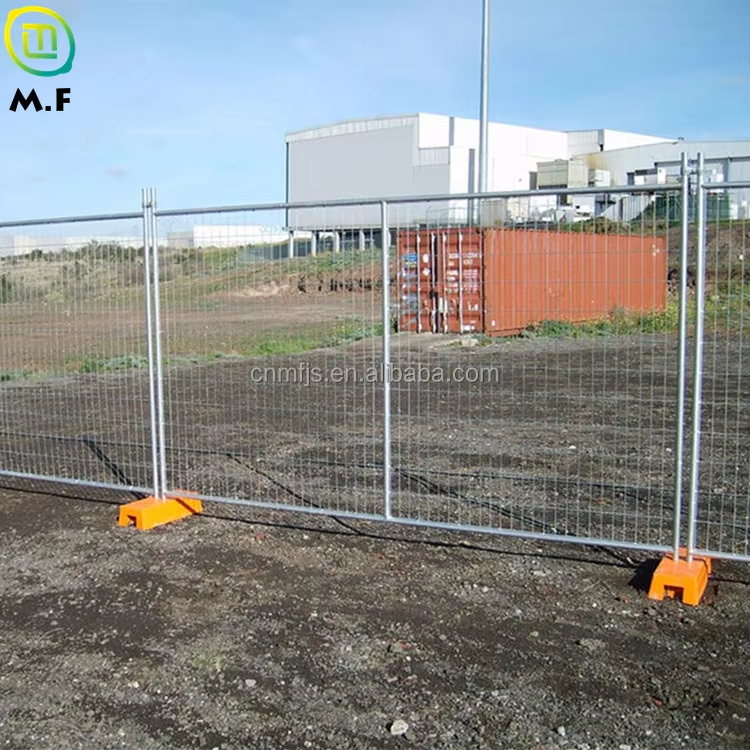
Wind-Resistant Temporary Fencing: Material Selection for High-Wind Environments
A standard 6x10-foot fence panel presents roughly 60 square feet of surface to the wind. At 45 mph, the force on that surface can exceed 300 pounds — enough to send an unsecured panel airborne. When temporary fencing fails in high wind, the consequences include property damage, roadway obstruction, and injury from flying panels.
The Aerodynamics of Fence Panel Design
Open Area Ratio and Wind Load
Wind force against a fence panel depends directly on how much air can pass through the surface. A solid panel — such as one fitted with privacy screening — catches wind like a sail and experiences maximum force. A panel with welded wire mesh openings allows partial airflow, reducing net wind load proportionally to the open area. A panel with 50x100mm mesh openings (approximately 60% open area) experiences roughly 40% of the wind load that a solid panel of identical dimensions would face.
This principle drives the first rule of wind-resistant temporary fencing: choose the largest mesh openings that still satisfy the barrier's functional purpose. Construction sites needing debris containment may require smaller openings. Event perimeters needing only crowd direction can use larger openings for superior wind performance.
Frame Stiffness and Connection Integrity
Wind forces concentrate at connection points between the panel and its support posts. A rigid welded steel frame — square tubing of 25x25mm or 30x30mm — transfers wind loads efficiently to posts and base plates. Lighter-gauge frames or mechanically fastened joints develop play over time, amplifying wind-induced vibration and accelerating fatigue failure.
The inter-panel connection design matters equally. Hook-and-eye connectors allow some independent panel movement, which dissipates wind energy but can also allow panels to separate under gusting. Rigid clamp connections, standard on construction-grade temporary fencing, create a continuous structure where wind loads distribute across multiple panels rather than concentrating on one weak point.
A coastal infrastructure project in Scotland deployed Australia-compliant temporary fencing from Hebei Maifa Metal Products Co., Ltd. after a wind study predicted gusts exceeding 55 mph. The panels used 50x100mm mesh openings with 30x30mm welded square tube frames and base plates ballasted with 25 kg concrete blocks at each post. The fencing survived three named storms over five months without a single panel failure.
Material Choices Under Wind Loading
Galvanized Steel: The Structural Standard
Hot-dip galvanized steel dominates temporary fencing for structural reasons. The Q235 substrate offers yield strength around 235 MPa, giving the welded frame the stiffness needed to resist wind-induced bending without permanent deformation. Pre-galvanized tube with additional powder coating — as used by Hebei Maifa Metal Products — adds an outer polymer layer that extends service life in harsh coastal and industrial atmospheres. The zinc coating thickness, typically 275 g/m² for hot-dip galvanizing, provides the corrosion protection that maintains structural integrity through years of wet and salty exposure.
Aluminum: Lightweight but Flexible
Aluminum temporary fencing weighs roughly one-third of equivalent steel panels — a genuine advantage for event crews. The tradeoff is stiffness. Aluminum's elastic modulus is approximately one-third that of steel, meaning an aluminum panel deflects three times more under identical wind load. This deflection can loosen connections and create fence-line gaps. Aluminum suits low-to-moderate wind environments.
Practical Wind Mitigation
Base Plate Ballasting
Standard base plates provide stability through friction with the ground, but at wind speeds above 30 mph, additional ballast becomes necessary. Concrete blocks, sandbags, or water-filled barriers on each base plate increase overturning resistance proportionally to added weight. Each post should resist an overturning moment equal to the wind pressure multiplied by panel area and half the panel height.
Panel Orientation and Post Spacing
Aligning fence lines parallel to prevailing wind direction reduces the projected area exposed to wind pressure. Where perpendicular orientation is unavoidable, installing posts at every panel joint rather than every second panel halves the load each connection point carries.
For wind-exposed sites, specify galvanized steel panels with large mesh openings, rigid clamp connections, and sufficient base plate ballasting. Hebei Maifa Metal Products Co., Ltd., an ISO9001-certified manufacturer, supplies temporary fencing with multiple mesh configurations and frame gauges for diverse wind exposure environments.
Frequently Asked Questions
What wind speed can temporary fencing withstand?
Standard galvanized steel temporary fencing with proper ballasting withstands sustained winds of 40–50 mph and gusts to 65 mph. Performance depends on panel open area ratio, frame gauge, base plate weight, and inter-panel connection type. Additional ballast extends the wind rating proportionally.
How do you secure temporary fencing in high winds?
Add 20–30 kg concrete ballast blocks or sandbags to every base plate. Use rigid clamp connections between panels rather than hook-and-eye. Install posts at every panel joint rather than every other panel. Orient fence lines parallel to prevailing winds where site layout permits.
Does mesh size affect wind resistance?
Significantly. Larger mesh openings allow more wind to pass through, reducing net load. A panel with 50x100mm openings experiences roughly 40% of the wind load of a solid panel. For windy locations, specify fencing from manufacturers like Hebei Maifa Metal Products Co., Ltd. with the largest openings that satisfy barrier requirements.
Is aluminum better than steel for wind resistance?
Aluminum is lighter and easier to handle but deflects more under wind load due to its lower elastic modulus. Steel panels provide greater stiffness and are preferred for high-wind locations. Aluminum suits moderate-wind environments where handling convenience is prioritized.
What base plate weight is needed for windy conditions?
Standard base plates weigh 5–10 kg for calm conditions. For sustained winds above 30 mph, add 20–30 kg ballast per post. Calculate required ballast based on panel area, expected wind pressure, and a safety factor of 1.5 against overturning.
Can temporary fencing stay up during a hurricane?
Temporary fencing should be dismantled before hurricane landfall. For deployment during hurricane season, maintain a documented takedown plan with trigger wind speeds, dedicated storage, and sufficient labor allocated for rapid disassembly. Panels left standing in hurricane-force winds become dangerous projectiles.